

Microsoft Is Merging Work and Personal Copilot Into One App — What Your Team Will Notice and What to Lock Down
Author: Dan Briggs | Published: 24 August 2026 | Reading time: 16 minutes
Executive summary: Microsoft began rolling out a single, unified Copilot app to web and mobile users worldwide in mid-August 2026, merging the Microsoft 365 Copilot work app and the consumer Copilot app into one product with one name, one icon and a new web address (Microsoft support notice, Message Center MC1454108). Staff can now sign in to the same app with a personal account, a work account, or both, and switch between them. The Windows and Mac desktop rollout follows in mid-September 2026. Underneath the rebrand sits a licensing shake-up: Microsoft ended support for the standalone Copilot Pro subscription on 1 August 2026 and now points home users to Microsoft 365 Premium at AU$33 a month, while the business-grade Microsoft 365 Copilot Business add-on is discounted to AU$26.91 per user per month until 30 September 2026. The work and personal sides of the app keep separate data by design, but putting both a click apart on every device raises the odds of business information ending up in a personal AI account that your organisation cannot see, manage or retrieve. This paper explains the rollout dates, the two quiet settings changes most businesses will miss, what it means for firms across Sydney, Brisbane, Melbourne and Central West NSW, and the eight checks worth doing before the desktop wave lands in September.
What Microsoft changed, and when
Until this month, Microsoft shipped two different Copilot apps. The Microsoft 365 Copilot app (the one that grew out of the old Office app) was the work version, tied to your business tenant and its security controls. The plain Copilot app was the consumer version, tied to personal Microsoft accounts. They had different icons, different URLs and different rules about where your data went. Confusion between the two has been constant since early 2024, and if we are candid, the question we hear most often from clients about Copilot is some version of: which one is the safe one?
Microsoft’s answer is to stop shipping two apps. Under Message Center notice MC1454108, published in August 2026, the Microsoft 365 Copilot app is being renamed to simply the Microsoft Copilot app, with a refreshed icon, and it now accepts personal accounts, work accounts, or both at once (summary by Microsoft MVP Vesa Nopanen). The worldwide rollout to web and mobile began in mid-August 2026, and the Windows and Mac desktop apps follow from mid-September 2026 (Windows Central).
The web address is changing too. The Copilot web app is moving from m365.cloud.microsoft to copilot.cloud.microsoft, with automatic redirection beginning in late August 2026. Because the new address stays under the *.cloud.microsoft domain, businesses that followed Microsoft’s recommended network configuration do not need firewall or allow-list changes.
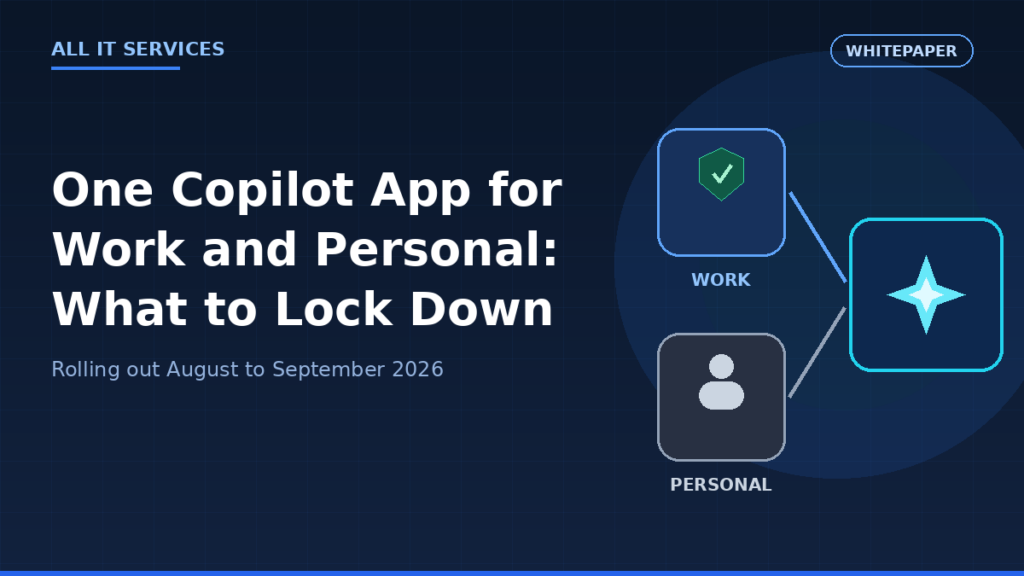
To tell the two worlds apart inside the one app, Microsoft has added visual cues: a different background colour for each account type, a Work label under the user’s profile in the navigation pane, and the familiar green data-protection shield on the work side. The account switcher works the same way it does in Outlook or Teams today.
At the same time, three consumer features are going away. From 18 August 2026, Microsoft retired Group Chat, Podcasts and Deep Research from the consumer Copilot app, and Group Chat content is not carried forward at all (TechRepublic). Anyone on your team who used those features personally has effectively already lost them.
The rollout timeline for Australian businesses
The dates below come from Microsoft’s Message Center notices and support documentation. Note how much of this lands inside a six-week window.
| Date | What happens | Who feels it |
|---|---|---|
| 1 August 2026 | Support ends for the standalone Copilot Pro consumer subscription | Staff who paid for Copilot Pro personally |
| Mid-August 2026 | Unified Copilot app rollout begins worldwide on web and mobile; opt-in early access opens for Windows and Mac | Everyone using Copilot in a browser or on a phone |
| 18 August 2026 | Group Chat, Podcasts and Deep Research retire from the consumer Copilot app; Group Chat content is not migrated | Personal-account users |
| Late August 2026 | Automatic redirect from m365.cloud.microsoft to copilot.cloud.microsoft begins; mobile Copilot Chat access controls change (MC1454386) | Web users; mobile fleets |
| 14 September 2026 | The =COPILOT function in Excel retires (MC1454373) | Anyone who adopted it from Insider or Frontier builds |
| Mid-September 2026 | Worldwide rollout of the unified Copilot desktop app for Windows and Mac | Every managed desktop and laptop |
| 30 September 2026 | Microsoft 365 Copilot Business add-on promotional pricing (AU$26.91 per user per month) ends | SMBs weighing up paid Copilot |
| Late September 2026 | Deferred URL redirect completes for web app holdouts | Tenants that deferred the change |
The practical reading of that table: your phones and browsers are changing right now, your desktops change in about three weeks, and the pricing decision worth modelling has a 30 September deadline.
What your team will notice from this week
Most of the visible changes are cosmetic, which is exactly why they generate helpdesk tickets. A new icon appears where the old Microsoft 365 Copilot icon used to sit, including on Windows taskbars. The app calls itself Microsoft Copilot instead of Microsoft 365 Copilot. Bookmarks to m365.cloud.microsoft start redirecting. On mobile, the app updates itself, or prompts staff to update, and the icon changes there too.
For staff who only ever use Copilot with their work sign-in, Microsoft says the changes are minimal: same chats, same agents, same green shield, same protections. Existing chat history, images and other created content migrate automatically. Files that were created with the old standalone consumer app move into OneDrive.
Three groups will notice more than cosmetics. Staff who used the consumer app’s Group Chat feature have lost those threads outright, because Microsoft did not carry Group Chat content forward past 18 August 2026. Staff who built Podcasts in Copilot needed to download them before retirement. And anyone who relied on consumer Deep Research for long-form reports will find it gone from the personal side of the app, which in our experience is precisely the moment they start running those queries on the work side instead. That is not a bad outcome, provided the work side is licensed and governed properly, which is the subject of the rest of this paper.
There is one more subtle shift. Because the app now accepts personal Microsoft accounts, and those accounts can be created with Google or Apple credentials, a work laptop can end up with a personal AI workspace one click from the corporate one, wearing the same icon. Microsoft has done a reasonable job of colour-coding the difference. Colour-coding is a hint, not a control, and busy people click past hints. We covered the behavioural side of this in our recent piece on shadow AI already operating inside Australian businesses; the unified app moves that problem from something staff had to seek out to something that ships in the box.
The work/personal boundary: what protects your data and what does not
Microsoft is clear about the architecture, and it is worth stating plainly because most of the anxiety we hear is about this exact point. Work accounts (Microsoft Entra ID) and personal accounts (Microsoft account) remain distinct by design. Data entered on the work side does not flow to the personal side, and data entered on the personal side does not flow to the work side. Tenant controls, compliance boundaries and enterprise data protection on the work side are unchanged by the merge, and the app’s Application ID is not changing, so existing policies keep applying (Microsoft support).
So the plumbing is fine. The risk is the human sitting in front of it. The two sides of the app answer to different legal frameworks: prompts typed into the work side are covered by Microsoft’s commercial data-protection commitments to your organisation, while prompts typed into the personal side are covered by Microsoft’s consumer privacy terms and belong to the individual, not the business. If a lawyer drafts advice in the wrong profile, or a bookkeeper pastes a client’s payroll export into a personal chat because the free personal tier felt identical, that content now lives in an account your business does not control, cannot audit, cannot place a legal hold on, and cannot wipe when the person resigns. Under the Privacy Act, your obligations to protect client information do not pause because the data left through a legitimately installed Microsoft app.
Our first-hand observation from managing Microsoft 365 environments across a few hundred Australian businesses: the failure mode is rarely malicious, and it is rarely even deliberate. It is a staff member on a busy Tuesday using whichever Copilot answered first. Before the merge, the consumer app at least looked different. After the merge, the difference is a background colour and a small Work label, and your protection depends on whether people were told what those cues mean. That is a communications job as much as a technical one, and it is cheap insurance: a two-paragraph staff notice this week costs nothing, while a client data incident report to the OAIC does not.
For businesses that want a hard edge rather than a soft cue, the controls exist. Tenant Restrictions can block personal Microsoft account sign-ins from managed devices and networks, conditional access can fence off unmanaged devices, and mobile application management can separate work data on phones. None of those switched themselves on when the new app arrived. If your policy position is that personal AI accounts have no place on company hardware, that position now needs enforcing, and it pairs naturally with a written policy — our guide to writing an AI use policy for your business covers the wording.
The licensing shake-up behind the rebrand
The app merge is the visible half of the story. The money half matters just as much, because August 2026 quietly redrew the consumer AI options your staff can buy with a personal credit card.
Microsoft ended support for Copilot Pro, its US$20-a-month consumer AI subscription, on 1 August 2026, having stopped selling it to new customers in October 2025 (Microsoft support). Its replacement is Microsoft 365 Premium, which costs AU$33.00 a month or AU$329.00 a year in Australia and bundles Copilot AI in Word, Excel, PowerPoint and Outlook with up to 6 TB of OneDrive storage (Microsoft Store Australia). It is a genuinely good consumer product, and that is the problem: it is priced and marketed so that a keen employee, contractor or volunteer can bring capable, unmanaged AI into your workplace for less than the cost of a business Copilot seat, and expense it as software.
We are already seeing the early version of this pattern in client environments: a staff member who personally paid for Copilot Pro gets the retirement email, upgrades to Microsoft 365 Premium at home, and keeps using it for work tasks on the grounds that it is faster than asking IT. Every one of those subscriptions is a private data store holding fragments of your business.
The correct response is not to ban AI, which fails, but to make the sanctioned path at least as convenient. On the business side, the current Australian options look like this (prices from the Microsoft 365 Copilot pricing page, paid yearly, as at August 2026):
| Option | Price (AUD, per user per month) | What it is |
|---|---|---|
| Microsoft 365 Copilot Chat | Included for eligible business plans | Secure, tenant-protected AI chat with the green shield; no Copilot inside Word, Excel or Outlook |
| Microsoft 365 Copilot Business (add-on) | AU$31.40, discounted to AU$26.91 until 30 September 2026 | Full Copilot in Microsoft 365 apps for businesses on Basic, Standard or Premium plans, up to 300 users |
| Microsoft 365 Business Standard with Copilot | AU$35.20 | Bundled licence and Copilot in one SKU |
| Microsoft 365 Business Premium with Copilot | AU$47.90 | The security-inclusive bundle we recommend most SMBs start from |
| Microsoft 365 Premium (consumer) | AU$33.00 flat | Personal subscription; no tenant protection, no admin visibility, not suitable for client or business data |
Two things stand out from that table. First, every business user in your tenant already has a free, protected AI chat in Copilot Chat, so nobody needs a personal account to get safe day-to-day AI assistance. Second, at AU$26.91 until 30 September, the discounted Copilot Business add-on is now cheaper than the consumer product your staff would otherwise buy themselves, which makes the business case unusually easy to run this quarter. If you trialled Copilot earlier in the year, the recent Copilot in 30 free trial mechanics and the billing checks we outlined there still apply; and if Copilot line items have crept onto your invoice without a decision being made, our earlier piece on Copilot becoming the default in Microsoft 365 explains what to audit.
Two quiet changes most IT teams will miss
Rebrand notices get read. The footnotes underneath them usually do not. Buried in the same August Message Center batch as the app merge are two settings changes that alter your actual security posture, and neither will announce itself.
Windows Recall filters do not carry over to the renamed app
If your organisation configured a group policy that excludes the old Microsoft Copilot app from Windows Recall snapshots, that filter does not automatically apply to the new Microsoft Copilot app. It has to be set up again for the new app. Any business that deliberately kept AI chat content out of Recall’s screenshot history, which is a sensible position for legal, health and finance practices, silently loses that exclusion when the new desktop app arrives in mid-September unless an administrator re-creates it. Diarise it for the desktop rollout week.
Mobile Copilot Chat restrictions are being switched off by default
Under Message Center notice MC1454386, two legacy mobile-only controls that previously restricted Copilot Chat on iOS and Android stop applying between mid-August and late September 2026, so that mobile access matches web and desktop. The change is on by default. If your tenant relied on those legacy controls to keep Copilot Chat off phones, that restriction is evaporating on Microsoft’s schedule, not yours, and any replacement needs to be built with current conditional access and app-management policy instead. Most businesses will be perfectly happy with Copilot Chat on mobile, since it carries enterprise data protection. The point is that it should be your decision rather than a default you discover later.
Neither of these items appeared in the consumer press coverage of the merge, and in our view they are the two most consequential lines in the whole announcement for regulated Australian businesses. This is the recurring lesson of Microsoft 365 administration: the headline change is rarely the risky one.
What we are telling clients in Sydney, Brisbane and the Central West
The advice changes with the shape of the business, so here is how we are framing it across our own client base.
For professional services firms on the Northern Beaches and across Sydney, the deadline that matters is mid-September, when the unified desktop app reaches managed Windows fleets. Accounting and legal practices around Brookvale that we support tend to run tightly managed laptops but loosely managed browsers, and the browser is where the personal side of Copilot now lives. Our recommendation is to decide the personal-account question before the desktop wave: either block personal Microsoft account sign-ins via Tenant Restrictions, or explicitly permit them and say so in the AI use policy, so nobody is guessing.
For accounting firms in Orange, Bathurst and Dubbo, the timing is awkward in a different way: the desktop change arrives in the run-up to the October tax lodgement peak, which is exactly when nobody has time for a surprise icon change or a Copilot that looks different from the training screenshots. We are advising Central West clients to send the staff notice now and schedule the five-minute toolbox talk for early September, rather than fielding confused calls in the busiest fortnight of the quarter. Regional firms also lean harder on mobile, which makes the MC1454386 mobile-access change worth an explicit look rather than an assumption.
For hospitality groups in Brisbane and Melbourne, the shared-device pattern is the one to watch. Venue iPads and back-office PCs with a rotating cast of casual staff are precisely where a personal Google-credentialed Copilot sign-in quietly becomes the house AI. Mobile application management and kiosk-style profiles close most of that gap, and the free Copilot Chat tier gives rostered managers a sanctioned tool so there is no reason to reach for a personal one.
For not-for-profits, the boundary issue is volunteers, who almost by definition bring personal accounts. NFPs handling beneficiary information should treat the unified app as the prompt to finally separate volunteer device access from staff device access, and the sector pricing conversation is worth having too, because donated and discounted Microsoft licensing changes the Copilot arithmetic materially.
The pre-September checklist
Eight checks, in the order we would run them for a typical 20-to-200-seat Australian business.
| # | Action | Why, and by when |
|---|---|---|
| 1 | Send a two-paragraph staff notice about the new name, icon and URL | Prevents helpdesk noise; before the desktop rollout in mid-September 2026 |
| 2 | Decide your personal-account position and enforce it (Tenant Restrictions, conditional access) or document that it is permitted | The one app now holds both worlds; before mid-September 2026 |
| 3 | Re-create Windows Recall exclusion filters for the renamed Copilot app | Existing filters do not carry over; during the desktop rollout window |
| 4 | Review mobile Copilot Chat access in light of MC1454386 defaults | Legacy mobile restrictions stop applying between mid-August and late September 2026 |
| 5 | Update training material, intranet screenshots and onboarding docs that show the old icon or m365.cloud.microsoft | Redirects begin late August 2026 |
| 6 | Tell finance to query expense claims for Microsoft 365 Premium and other personal AI subscriptions | Copilot Pro’s retirement on 1 August 2026 is pushing staff to AU$33/month personal plans |
| 7 | Model the Copilot Business add-on at AU$26.91 per user per month against actual usage | Promotional price ends 30 September 2026 |
| 8 | Refresh the AI use policy so it names the unified app and the work/personal cues | Policy should match what staff actually see on screen |
None of these is a large project. Together they take an afternoon with the right admin access, and they convert Microsoft’s timetable into your timetable.
Frequently asked questions
Will our staff’s personal Copilot chats mix with our business data?
No. Microsoft keeps personal (Microsoft account) and work (Entra ID) experiences separate by design, and data does not flow between them. The real risk is a person typing business information into the personal side by mistake, because both now live in one app. Visual cues help; clear policy and, where needed, blocking personal sign-ins on managed devices help more.
Do we need to change our firewall or allow-lists for the new copilot.cloud.microsoft address?
Generally no. The new URL stays within the *.cloud.microsoft domain, so businesses that follow Microsoft’s recommended network configuration for Microsoft 365 need no additional network changes. The old address redirects automatically from late August 2026.
Some of our team paid for Copilot Pro personally. What should they do now?
Copilot Pro support ended on 1 August 2026. For home use, Microsoft 365 Premium at AU$33 a month is the like-for-like replacement. For anything touching work, the answer should be a business licence in your tenant: free Copilot Chat for everyday use, or the Copilot Business add-on (AU$26.91 per user per month until 30 September 2026) for Copilot inside Word, Excel and Outlook.
Can we stop staff signing in to Copilot with personal accounts on work devices?
Yes. Tenant Restrictions can block personal Microsoft account sign-ins from your managed devices and network, and conditional access plus mobile application management extend that control to phones. The unified app does not weaken those controls, and its Application ID is unchanged, so existing policies continue to apply.
Is the discounted Copilot Business pricing worth acting on?
If you were going to buy paid Copilot seats within the next two quarters anyway, buying before 30 September 2026 at AU$26.91 rather than AU$31.40 per user per month saves about 14 per cent for the promotional period, and it lands the rollout while staff attention on Copilot is already high. If you have no current use case, a cheaper price for something you do not need is still a cost; run a small pilot against measurable tasks first.
Next steps
The unified Copilot app is a sensible product decision by Microsoft, and for well-governed businesses it will make the safe path clearer, not murkier. The work is in the fortnight before the desktop rollout: tell your people what is changing, close the two quiet policy gaps, and make a deliberate licensing call while the promotional maths favours you.
If you would like a second pair of eyes across your tenant before mid-September, whether that is checking Tenant Restrictions, re-building Recall filters, or modelling Copilot licensing against what your team actually does all day, we do this every week for businesses across Sydney, Brisbane, Melbourne and Central West NSW. Call All IT Services on 1300 425 548 or get in touch online.