

How to Connect Business Systems with AI

Most businesses are sitting on more data than they know what to do with. They've got a ticketing system, a telephony platform, a CRM, an accounting tool, maybe some HR software. Each one doing its job. Each one holding a piece of the picture. The problem isn't the data.
The problem is that the picture has never been whole.
Getting system, A to talk to system B used to mean hiring a developer, negotiating APIs that weren't designed to connect, and waiting weeks for something that still didn't quite work. When it did work, you got a static dashboard that told you what happened last month. That's not insight. That's a history lesson.
Something shifted at the end of 2024 that's changed this significantly - and it's now accessible to businesses that couldn't have touched it twelve months ago.
Most businesses are sitting on more data than they know what to do with. They've got a ticketing system, a telephony platform, a CRM, an accounting tool, maybe some HR software. Each one doing its job. Each one holding a piece of the picture. The problem isn't the data.
The problem is that the picture has never been whole.
Getting system, A to talk to system B used to mean hiring a developer, negotiating APIs that weren't designed to connect, and waiting weeks for something that still didn't quite work. When it did work, you got a static dashboard that told you what happened last month. That's not insight. That's a history lesson.
Something shifted at the end of 2024 that's changed this significantly - and it's now accessible to businesses that couldn't have touched it twelve months ago.
Take a service business with a call centre. They've got a job logging system and a telephony platform. Both have been running for years. Both hold useful data. But they've never spoken to each other.
Now, when a customer calls about a warranty claim, the AI can match what's being said on the call against what's recorded in the system, including what product was sold, what warranty applies, and what the customer was told previously. If a team member gives incorrect information, it gets flagged quickly. Not at the next monthly review. Not when the customer complains. Almost immediately.
That's better training, better expectation-setting for the customer, and fewer problems that fester into bigger ones.
For a not-for-profit, the same logic applies differently. Tracking activity is not the same as tracking impact. A lot of organisations know they ran a programme. Fewer can tell you whether it worked for the people it was designed to serve, and whether resources would be better directed somewhere else. Connecting the right systems makes that measurable without a team of analysts.
For hospitality groups, matching staffing data to sales data to supplier costs can reveal margin issues that were invisible before, simply because the information lived in three separate places.
What used to take three or four days of pulling reports from multiple providers, consolidating them, and interpreting the output can now happen in a fraction of that time. More importantly, the questions you can ask of the data are no longer limited to what a report was pre-built to show you.
There's also a cost benefit that often surprises people. Many businesses carry several subscriptions specifically for reporting and process automation. When your core systems are connected properly and an AI can interpret across them, a number of those ancillary tools become redundant. That's a real reduction in subscription costs that typically follows within weeks of implementation.
The most important thing here is to come with problems, not destinations. Don't start from "we want AI." Start from "we've got a manual process that produces errors," or "we're making decisions without the data we need," or "we don't actually know what our clients experience when things go wrong."
When the right questions are on the table, the scope of what's possible usually surprises people. The systems are often already there. The data already exists. The gap is connecting it in a way that makes it useful. If you're curious about where this could apply in your business, the best next step is a conversation. Not a pitch. A conversation about what's not working, where the manual effort is, and what you'd do differently if the data were in front of you.
Start there, and the rest tends to open up quickly.
Watch & Learn
Explore our curated collection of videos designed to inform and inspire.
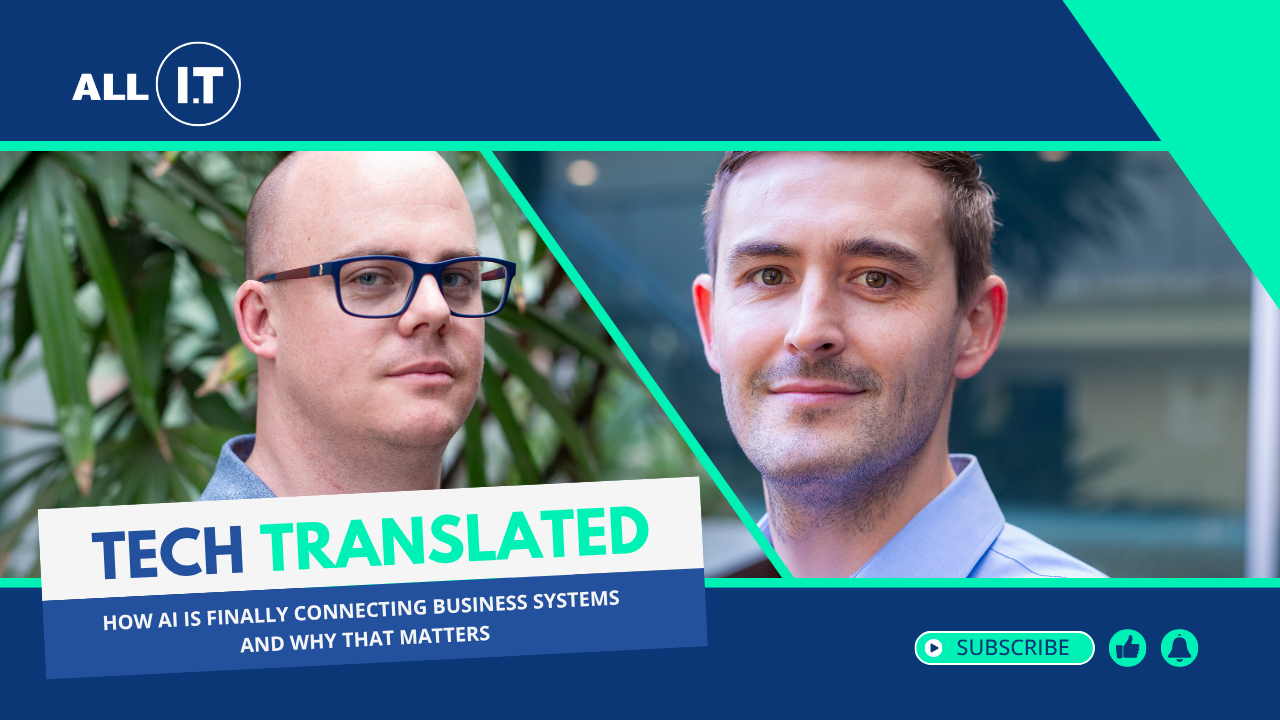
How We’re Using AI to Lift Service Quality and Save Hours of Reporting
Dan Briggs and Nathan Hutchison demonstrate how we’ve connected our ticketing system and 3CX telephony using AI and Model Context Protocol (MCP) to automate service quality analysis and daily reporting. This work used to take hundreds of hours.